
Wednesday, August 10, 2011
Japanese Beetles
They're everywhere! And they haven't just confined themselves to my roses - I've seen them on the zinnias, too!


Monday, August 08, 2011
Tonight's Dinner
Straight from the garden ...

The produce is far more beautiful than my broken birdbath. ;(
At 6:00 are some awesome black cherry tomatoes that are like candy. There's also one Principe Borghese tomato there, too (I think that's the first one to make it in the house - I usually just eat them in the garden!). At Noon are a couple of sweet cherry peppers and a few more ground cherries. And there are two different kinds of cucumbers there, too.
There are a couple of gorgeous looking eggplant out there, too, but they'll have to wait for a different dinner.
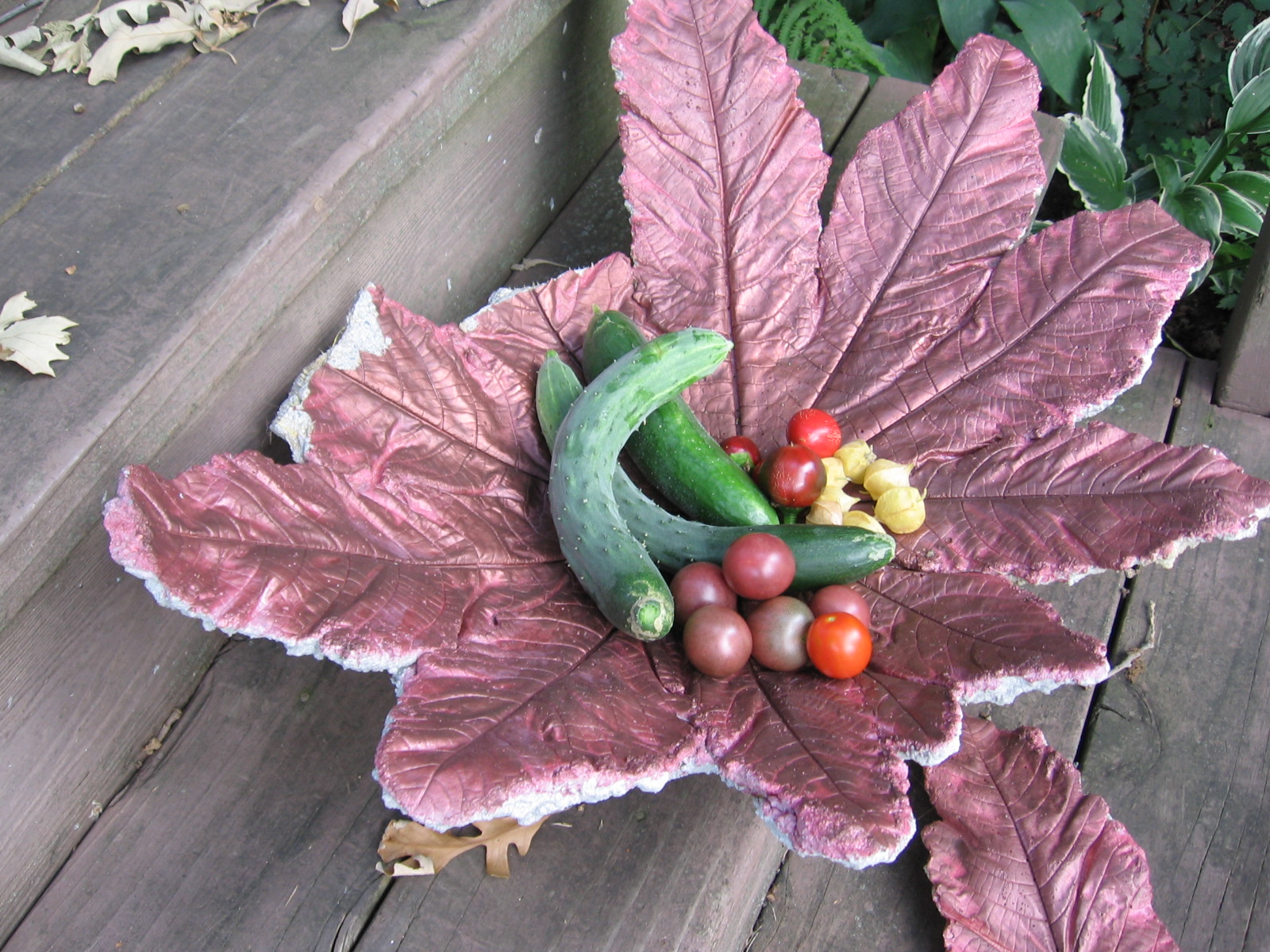
The produce is far more beautiful than my broken birdbath. ;(
At 6:00 are some awesome black cherry tomatoes that are like candy. There's also one Principe Borghese tomato there, too (I think that's the first one to make it in the house - I usually just eat them in the garden!). At Noon are a couple of sweet cherry peppers and a few more ground cherries. And there are two different kinds of cucumbers there, too.
There are a couple of gorgeous looking eggplant out there, too, but they'll have to wait for a different dinner.
Saturday, August 06, 2011
Ground Cherries

You can tell the ones that were just picked today - the husks are still slightly green. They seem to have excellent shelf life, much like tomatillos.
In addition to jam, I'm thinking: ice cream, in place of blueberries in bread/muffins, salsa, frozen in drinks ...
Friday, August 05, 2011
DIY Earring Organizer

I finally finished a little project that's been rolling around in my head for about two years. My earrings were spilling all over the place - they were in my bedroom, in the bathroom, in the living room - basically where ever I happened to be standing when I realized that my earrings were driving me nuts and needed to be taken out!
My mom was getting rid of this picture frame at a garage sale and I snatched it up thinking it would be perfect for this project. The pictures don't really do it justice - it's hanging in the bathroom and I just can't get enough decent light in there.
 The project is super simple: all you need is a picture frame, some window screening, a pretty piece of fabric, a glue gun and a staple gun.
Cut the screen to fit the in the inside lip of the opening and use your glue gun to keep the screen in place. And then stretch a piece of fabric to the back of the frame and staple in place. Done. And totally functional. No more earrings in the living room!
Tuesday, August 02, 2011
Better Living Through Chemistry: Sauerkraut (and pickles and beets)!
The mad scientist in me came out in full-force on Friday. I had been doing extensive reading on fermented foods: sauerkraut, pickles, beans, beets, etc and decided that I must give it a try!
My grandparents made gallons of sauerkraut every year - seriously - I think they had a 5 gallon crock (of course, I can't remember what I had for breakfast, so remembering back 30 years is really a stretch). In any case, to my pre-teen brain, it seemed like gallons and gallons of the stuff were put up for the winter. And I loved every minute of the process. Sometimes I dream about Grandma with her hands on top of mine, showing me the proper way to punch down the salty cabbage to extract all of the juices. It seemed so simple and magical then - cabbage, salt, and a couple weeks' time was all you needed to have delicious sauerkraut. It's a wonder I haven't tried to make it sooner.
But I didn't try to make it sooner because once I started reading about it, it freaked me out. Food safety is my profession and fermenting foods at room temperature goes against everything I've been taught. Silly, really ... people have survived for thousands of years eating fermented foods. In fact, they were probably much healthier for it. I eat fermented foods all the time: bread, yogurt, soy sauce, kimchi, sauerkraut, miso, beer, wine, pickles, kefir, olives, vinegar ... the list goes on and on. I make my own yogurt and vinegar, so pickled veggies seemed like a logical step. And given what I know about fermentation and food spoilage, I figured the food would surely look/smell "off" if it was really dangerous! ;)
 Friday's fermenting adventures started with a trip to the farmer's market. My cabbage was pillaged by bettles, slugs, squirrels, and who knows what else. I got two gorgous heads for $2. Bargain. So much so in fact, that I might not even bother trying to grow it anymore - although I do think it's one of the prettiest veggies in the garden and looks wonderful right next to the coneflowers and day lilies. I also picked up a bunch of beets. I have cucumbers growing at home and knew that before long I would have them coming out my ears, so I didn't feel the need to buy any (besides, they were all too big for pickling, in my opinion).
I cored the cabbage, quartered it, and sliced it thinly. As each shredded quarter went into the big bowl (glass or plastic only), I sprinkled on a hearty pinch of kosher salt (honestly, I didn't measure, but it was probably just shy of a teaspoon). And then I started packing it tightly into the 1.5 gallon jar. The jar to the left is filled with one head of shredded, salted cabbage. I put both heads of shredded cabbage into the jar - and think I could probably fit 4 heads in this jar (as it starts to release some juice, you can pack it down tighter and tighter and it really does become quite compact). Anyway, every hour or so, I went by and packed it down a little tighter with a wooden mallet (I think we used to use our knuckles at Grandma's house). After 4-5 hours, I had enough juice extracted that it completely covered the top of the shredded cabbage (I have read that sometimes older cabbages are dryer and it can take as long as 24 hours before enough liquid is extracted to completely submerge the shredded cabbage).
It's critical that all of the cabbage be submerged below the liquid line. There are lots of methods for doing this, but I took the easy way out and partially filled a Ziplock gallon storage bag with water and put it in the jar on top of the cabbage. And then I set the cover loosely on the jar. The bag holds the cabbage down under the brine line, and also forms a nice seal so that there's no way for the air to get to the brine and cause spoilage. CAUTION: if you're doing this in a jar, set your jar on a plate with a substantial lip - as the fermentation begins, it will bubble over the top of the jar and on to your counter - or plate.
And now the Cliff Claven in me is showing: if you want a comprehensive resource on fermented foods found worldwide, the Food and Agriculture Organization (FAO) of the UN has a lengthy bulletin describing fermented foods and the science behind making them. You'll find everything from sauerkraut and dill pickles to banana beer and fermented tea leaves. It's really quite fascinating. Of course, I'm a total nerd, so take that into consideration before reading the book and then droning on to me about how boring it is!
There is also Preserving Food without Freezing or Canning if you're looking for something more along the lines of a recipe book. I find this book is more a collection of "this-is-how-my-mother-did-it" type of recipes rather than strict measures and instructions. This book includes some really interesting ideas - without all of the pesky science background - that I'd love to try out some day.
More on how the kraut is tasting - and reports on the beets and pickles next time ...
UPDATED: Just in case you want a "real" recipe for making sauerkraut, you can find several here (in addition to the info in the FAO publication):
Wild Fermentation
Mother Earth News
UMN Extension
My grandparents made gallons of sauerkraut every year - seriously - I think they had a 5 gallon crock (of course, I can't remember what I had for breakfast, so remembering back 30 years is really a stretch). In any case, to my pre-teen brain, it seemed like gallons and gallons of the stuff were put up for the winter. And I loved every minute of the process. Sometimes I dream about Grandma with her hands on top of mine, showing me the proper way to punch down the salty cabbage to extract all of the juices. It seemed so simple and magical then - cabbage, salt, and a couple weeks' time was all you needed to have delicious sauerkraut. It's a wonder I haven't tried to make it sooner.
But I didn't try to make it sooner because once I started reading about it, it freaked me out. Food safety is my profession and fermenting foods at room temperature goes against everything I've been taught. Silly, really ... people have survived for thousands of years eating fermented foods. In fact, they were probably much healthier for it. I eat fermented foods all the time: bread, yogurt, soy sauce, kimchi, sauerkraut, miso, beer, wine, pickles, kefir, olives, vinegar ... the list goes on and on. I make my own yogurt and vinegar, so pickled veggies seemed like a logical step. And given what I know about fermentation and food spoilage, I figured the food would surely look/smell "off" if it was really dangerous! ;)
 Friday's fermenting adventures started with a trip to the farmer's market. My cabbage was pillaged by bettles, slugs, squirrels, and who knows what else. I got two gorgous heads for $2. Bargain. So much so in fact, that I might not even bother trying to grow it anymore - although I do think it's one of the prettiest veggies in the garden and looks wonderful right next to the coneflowers and day lilies. I also picked up a bunch of beets. I have cucumbers growing at home and knew that before long I would have them coming out my ears, so I didn't feel the need to buy any (besides, they were all too big for pickling, in my opinion).
I cored the cabbage, quartered it, and sliced it thinly. As each shredded quarter went into the big bowl (glass or plastic only), I sprinkled on a hearty pinch of kosher salt (honestly, I didn't measure, but it was probably just shy of a teaspoon). And then I started packing it tightly into the 1.5 gallon jar. The jar to the left is filled with one head of shredded, salted cabbage. I put both heads of shredded cabbage into the jar - and think I could probably fit 4 heads in this jar (as it starts to release some juice, you can pack it down tighter and tighter and it really does become quite compact). Anyway, every hour or so, I went by and packed it down a little tighter with a wooden mallet (I think we used to use our knuckles at Grandma's house). After 4-5 hours, I had enough juice extracted that it completely covered the top of the shredded cabbage (I have read that sometimes older cabbages are dryer and it can take as long as 24 hours before enough liquid is extracted to completely submerge the shredded cabbage).
It's critical that all of the cabbage be submerged below the liquid line. There are lots of methods for doing this, but I took the easy way out and partially filled a Ziplock gallon storage bag with water and put it in the jar on top of the cabbage. And then I set the cover loosely on the jar. The bag holds the cabbage down under the brine line, and also forms a nice seal so that there's no way for the air to get to the brine and cause spoilage. CAUTION: if you're doing this in a jar, set your jar on a plate with a substantial lip - as the fermentation begins, it will bubble over the top of the jar and on to your counter - or plate.
And now the Cliff Claven in me is showing: if you want a comprehensive resource on fermented foods found worldwide, the Food and Agriculture Organization (FAO) of the UN has a lengthy bulletin describing fermented foods and the science behind making them. You'll find everything from sauerkraut and dill pickles to banana beer and fermented tea leaves. It's really quite fascinating. Of course, I'm a total nerd, so take that into consideration before reading the book and then droning on to me about how boring it is!
There is also Preserving Food without Freezing or Canning if you're looking for something more along the lines of a recipe book. I find this book is more a collection of "this-is-how-my-mother-did-it" type of recipes rather than strict measures and instructions. This book includes some really interesting ideas - without all of the pesky science background - that I'd love to try out some day.
More on how the kraut is tasting - and reports on the beets and pickles next time ...
UPDATED: Just in case you want a "real" recipe for making sauerkraut, you can find several here (in addition to the info in the FAO publication):
Wild Fermentation
Mother Earth News
UMN Extension
Subscribe to:
Posts (Atom)